Parkinson's Disease Doctor in Kanpur
Living with Parkinson’s disease is challenging, not just for the patient but for the entire family. The trembling hands, the stiffness in the morning, the slow and shuffling steps — these symptoms can be frightening, especially when you do not know where to turn for reliable help in Kanpur.
Dr. Zubair Sarkar, a highly qualified Consultant Neurologist and the best neuro-physician in kanpur with a DM in Neurology from Sanjay Gandhi Postgraduate Institute of Medical Sciences (SGPGI), Lucknow, and SCE Neurology certification from the Royal College of Physicians, UK, provides advanced, evidence-based Parkinson’s disease treatment at his neurology clinic in Harsh Nagar, Kanpur.
With 12+ years of experience and over 50,000 neurological consultations, Dr. Zubair Sarkar brings the kind of specialist expertise in movement disorders that patients across Kanpur and nearby districts of Unnao, Fatehpur, and Kannauj trust for accurate diagnosis and long-term care.
If you or a loved one is experiencing tremors, stiffness, or difficulty with movement, early consultation with a Parkinson’s specialist can make a significant difference in managing the condition and preserving quality of life.
What Is Parkinson's Disease?
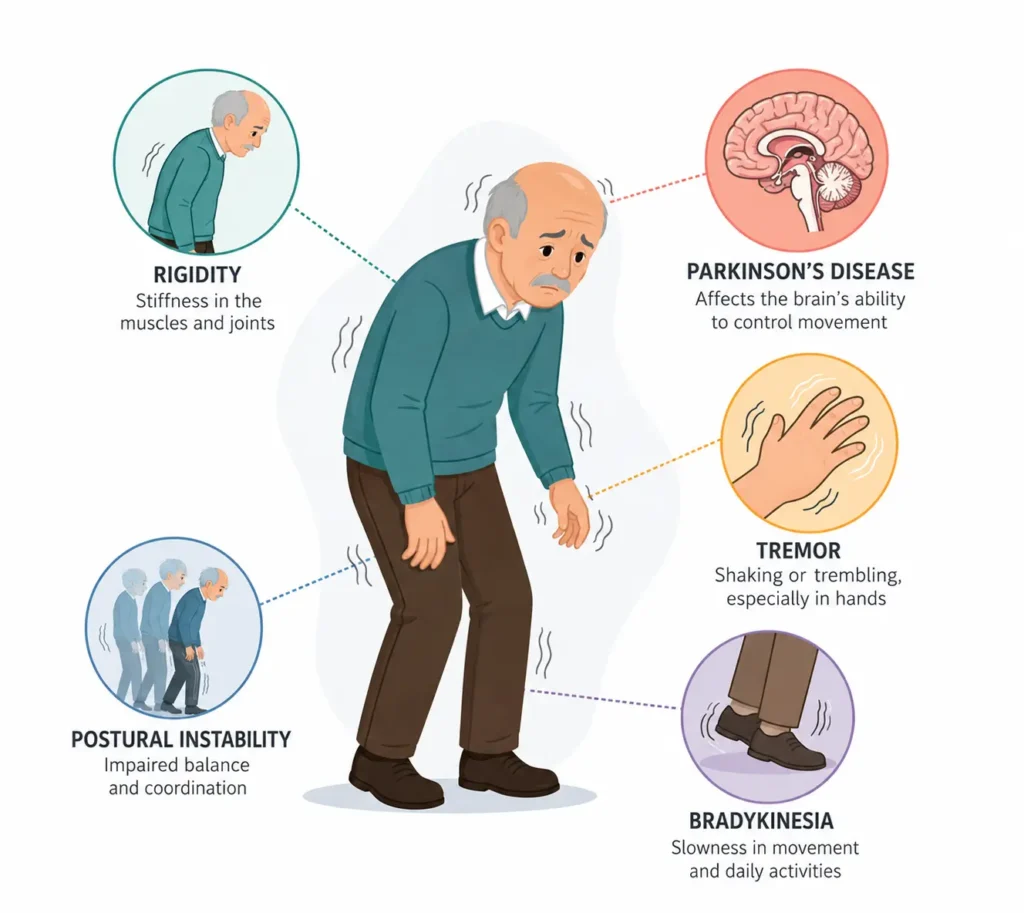
Parkinson’s disease is a progressive neurological disorder caused by the gradual loss of dopamine-producing nerve cells in the brain. As dopamine levels fall, the brain loses its ability to coordinate smooth, controlled movement, leading to the motor and non-motor symptoms that define this condition.
While Parkinson’s disease cannot be cured, it can be effectively managed with the right treatment plan. The key is early diagnosis, specialist-guided medication, and consistent long-term monitoring — all of which are available at Dr. Zubair Sarkar’s neurology clinic in Kanpur.
Dr. Zubair Sarkar specializes in the complete spectrum of movement disorder care, from initial evaluation and accurate diagnosis to personalized medication management and advanced treatment planning. His training at SGPGI Lucknow, one of India’s foremost neurology institutes, and his international SCE certification from the Royal College of Physicians, UK, give his patients access to a standard of neurological care that is rarely available locally in Kanpur.
Patients who begin treatment early — before symptoms significantly impact daily life — generally experience better long-term outcomes, greater independence, and a higher quality of life. This is why consulting a qualified Parkinson’s disease specialist in Kanpur at the earliest sign of symptoms is strongly recommended.
How Dr. Zubair Sarkar Approaches Your Care
Dr. Zubair Sarkar follows a structured, patient-centered approach to epilepsy diagnosis and ongoing management. Every new patient begins with a thorough clinical history covering seizure description, onset pattern, frequency, duration, known triggers, prior treatment history, and family history of neurological conditions.
This is followed by targeted diagnostic evaluation including an electroencephalogram (EEG) to record and analyze brain electrical activity, brain MRI to identify any structural or lesional cause, and blood investigations to rule out metabolic, infectious, or systemic triggers.
Based on these findings, Dr. Sarkar develops a personalized treatment plan tailored to the specific seizure type, epilepsy syndrome, patient age, occupation, lifestyle, and medical comorbidities. Patients are not placed on a generic protocol. Each treatment decision is evidence-based, reassessed at every follow-up appointment, and adjusted in response to clinical progress and patient feedback.
Recognising the Signs
Parkinson’s disease does not appear suddenly. It develops gradually, often beginning with symptoms so subtle that patients and families dismiss them for months or even years. Recognizing the early warning signs and seeking timely evaluation is one of the most important steps toward effective management.
Early Warning Signs
The earliest signs of Parkinson’s disease are often easy to overlook or misattribute to aging or fatigue. Common early symptoms include:
- A slight, rhythmic tremor or shaking in one hand, finger, or foot, most noticeable when the limb is at rest
- Stiffness in the arms, legs, or shoulders that does not improve with movement
- Handwriting that becomes progressively smaller and more cramped (micrographia)
- A reduced sense of smell without any apparent cause
- Difficulty sleeping, including acting out dreams or restless leg sensations
- A softer, lower voice or changes in speech clarity
- Reduced facial expressions, sometimes described as a “masked face” by family members
- Constipation or digestive slowness without a dietary reason
These early symptoms are frequently attributed to stress, aging, or general fatigue. However, when two or more of these signs appear together, especially in individuals above the age of 50, a neurological evaluation is recommended.
As the Disease Progresses
As Parkinson’s disease progresses, symptoms become more noticeable and begin to impact daily functioning. Advanced symptoms include:
- Bradykinesia — a significant slowing of all voluntary movements, making simple tasks like buttoning a shirt or rising from a chair increasingly difficult
- A stooped posture with a tendency to lean forward
- A shuffling, short-step walking pattern with reduced arm swing
- Balance difficulties and an increased risk of falls
- Freezing episodes where the patient suddenly stops mid-movement and cannot initiate the next step
- Swallowing difficulties and drooling
- Cognitive changes including memory difficulties, confusion, or early dementia
- Depression, anxiety, and emotional changes
- Bladder control difficulties
- Low blood pressure upon standing (orthostatic hypotension)
Non-motor symptoms such as depression, sleep disturbance, and cognitive changes are often underrecognized but can be just as disabling as the physical symptoms of Parkinson’s disease.
When Should You See a Neurologist?
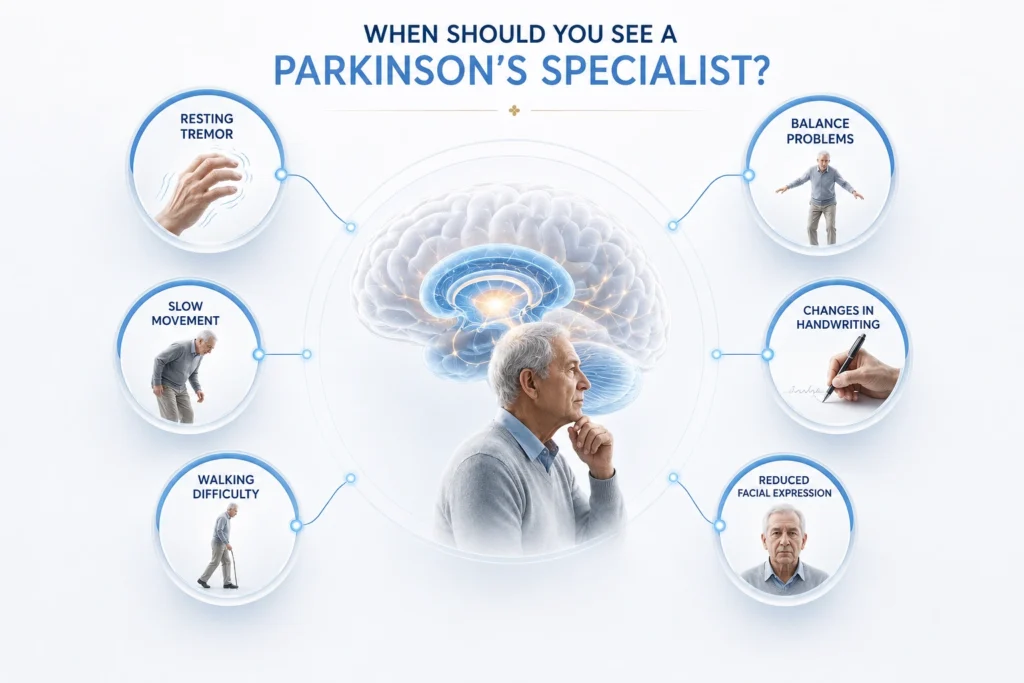
You should consult a Parkinson’s disease specialist in Kanpur if you or a family member notices:
- Tremors or shaking in the hands, fingers, jaw, or legs that appear at rest
- Persistent stiffness or rigidity in the limbs or neck
- Noticeably slowed movements in daily activities
- Unexplained balance problems or repeated falls
- A change in walking pattern or posture
- Gradual changes in speech, handwriting, or facial expression
- Two or more early symptoms appearing together over weeks or months
Early evaluation does not always confirm Parkinson’s disease, but it rules out other treatable conditions and ensures that if Parkinson’s is present, treatment begins at the most beneficial stage.
There is no single treatment approach for Parkinson’s disease. The right treatment plan depends on the patient’s age, stage of the disease, predominant symptoms, overall health, and response to medication. Dr. Zubair Sarkar develops individualized treatment plans for every Parkinson’s patient, combining medication, therapy, and lifestyle guidance based on their specific needs.
Medication Management
Medication remains the foundation of Parkinson’s disease treatment, particularly in the early and middle stages. Dr. Zubair Sarkar prescribes and carefully monitors dopamine-based medications to control motor symptoms and preserve daily functioning.
Commonly used medications include:
- Levodopa combined with Carbidopa — the most effective medication for controlling motor symptoms. It works by replenishing dopamine in the brain and remains the gold standard treatment for most patients
- Dopamine Agonists — medications that mimic the effect of dopamine and are often used in younger patients or as a complement to Levodopa therapy
- MAO-B Inhibitors — medications that slow the breakdown of dopamine in the brain, helping extend the duration of symptom control
- COMT Inhibitors — used to prolong the effectiveness of Levodopa by reducing its breakdown in the body
- Anticholinergic medications — used selectively for tremor control in specific patient profiles
Medication management for Parkinson’s is not a one-time prescription. It requires regular follow-up, dose adjustments, and monitoring for side effects. Dr. Zubair Sarkar provides ongoing neurological supervision to ensure that each patient’s medication plan continues to work effectively as the disease progresses.
Physiotherapy and Rehabilitation
Physiotherapy is an essential component of Parkinson’s disease management that directly improves quality of life. Dr. Zubair Sarkar recommends structured physiotherapy and rehabilitation programs tailored to each patient’s stage of disease, focusing on:
- Improving balance, coordination, and posture
- Reducing the risk of falls through gait training
- Maintaining muscle strength and joint flexibility
- Speech therapy for patients experiencing voice changes or swallowing difficulties
- Occupational therapy to support independence in daily activities
- Exercise programs designed for Parkinson’s patients, including walking, cycling, and targeted strength training
Research consistently shows that Parkinson’s patients who combine medication with regular physical activity and physiotherapy maintain better motor function and independence for longer than those who rely on medication alone.
Advanced Treatment and Deep Brain Stimulation
For patients with advanced Parkinson’s disease whose symptoms are no longer adequately controlled by medication, or who experience significant medication-related side effects such as dyskinesia (involuntary movements), advanced treatment options are available.
Deep Brain Stimulation (DBS) is a surgical procedure in which electrodes are implanted in specific areas of the brain and connected to a pulse generator placed under the skin of the chest. The device delivers controlled electrical impulses that regulate abnormal brain activity responsible for Parkinson’s symptoms.
DBS is not a cure for Parkinson’s disease, but it can dramatically reduce tremors, rigidity, and medication fluctuations in carefully selected patients. Dr. Zubair Sarkar evaluates each patient comprehensively to determine whether they are appropriate candidates for advanced interventional treatment and provides specialist referral where surgical options are indicated.
Not every patient with Parkinson’s disease requires surgery. The majority of patients are effectively managed with medication and supportive therapies for many years. Dr. Zubair Sarkar’s approach prioritizes the most appropriate, least invasive treatment at every stage of the disease.
Patients with drug-resistant epilepsy should not conclude that their condition is beyond treatment. With the right specialist guidance and an individualized management plan, many patients achieve meaningful seizure reduction and significant improvement in daily functioning and quality of life.
Why Patients Choose Dr. Zubair Sarkar
Choosing the right neurologist for Parkinson’s disease is one of the most important decisions a patient and their family will make. Dr. Zubair Sarkar stands apart as one of the most qualified and experienced Parkinson’s disease specialists available in Kanpur.
Qualifications
- MBBS, MD Medicine — Aligarh Muslim University (AMU), Aligarh
- DM Neurology — Sanjay Gandhi PGI (SGPGI), Lucknow
- DrNB Neurology
- SCE Neurology — Royal College of Physicians, UK (RCP-UK)
- MNAMS
12+ years
of specialized neurological practice
50,000+
neuro consultations completed
Specialist training at two of India's most respected neurology institutions
International neurology certification from the Royal College of Physicians, UK
Expert in ischemic stroke, hemorrhagic stroke, TIA, and stroke paralysis
Evidence-based, personalized treatment — not a generic protocol
Clear communication and a patient-first approach
Trusted by patients from Kanpur, Unnao, Fatehpur, Kanpur Dehat, and surrounding regions
Frequently Asked Questions
Q1. Is Parkinson's disease curable?
Parkinson’s disease currently has no cure. However, it is a manageable condition. With an accurate diagnosis, appropriate medication, physiotherapy, and regular specialist follow-up, most patients can maintain a good quality of life and continue daily activities for many years after diagnosis. Early treatment consistently leads to better long-term outcomes
Q2. What are the first warning signs of Parkinson's disease?
The earliest signs include a mild resting tremor in one hand or finger, slight stiffness in the arms or legs, reduced facial expression, smaller handwriting, and a softening of the voice. Sleep disturbances and a reduced sense of smell can also be early indicators. If you notice two or more of these signs, a neurological evaluation is recommended.
Q3. Which doctor should I consult for Parkinson's disease in Kanpur?
Parkinson’s disease should be evaluated and managed by a qualified neurologist, specifically one with experience in movement disorders. Dr. Zubair Sarkar, a DM Neurologist with SCE Neurology (RCP-UK) certification and 12+ years of experience, is one of the most qualified Parkinson’s disease specialists available in Kanpur.
Q4. How is Parkinson's disease diagnosed?
There is no single test to diagnose Parkinson’s disease. Diagnosis is primarily clinical, based on a detailed neurological examination, review of symptoms, and medical history. Dr. Zubair Sarkar may also recommend brain imaging such as MRI to rule out other neurological conditions and confirm the diagnosis accurately.
Q5. Can Parkinson's symptoms be controlled with medication alone?
In the early and middle stages of Parkinson’s disease, medication — particularly Levodopa-based therapy — can effectively control motor symptoms and allow patients to maintain normal daily functioning. Most patients are managed with medication for many years before advanced interventions become necessary, if at all. Regular follow-up with a neurologist is essential to adjust medication as the disease progresses.
Q6. What is the cost of Parkinson's disease treatment in Kanpur?
The cost of Parkinson’s disease treatment in Kanpur varies depending on the stage of the disease, the medications prescribed, and the frequency of follow-up consultations. Dr. Zubair Sarkar’s clinic offers transparent, affordable consultation fees. For specific information about consultation charges and treatment costs, please contact the clinic directly at 7897502902.
Q7. At what age does Parkinson's disease typically begin?
Parkinson’s disease most commonly appears in individuals over the age of 60. However, early-onset Parkinson’s disease can occur in individuals as young as 40 to 50 years of age. Men are slightly more likely to develop Parkinson’s disease than women. Age remains the single most significant risk factor for the condition.
Q8. Does Dr. Zubair Sarkar treat advanced Parkinson's disease?
Yes. Dr. Zubair Sarkar provides specialist care for Parkinson’s disease at all stages, from early diagnosis to advanced disease management. For patients with complex medication needs, significant motor fluctuations, or those requiring evaluation for advanced treatment options such as Deep Brain Stimulation, Dr. Zubair Sarkar offers comprehensive neurological assessment and specialist guidance.
If you or a family member is experiencing tremors, stiffness, slow movement, or any other symptoms associated with Parkinson’s disease, do not delay your consultation. Early evaluation by a specialist neurologist gives you the best opportunity for effective symptom control, preserved independence, and better long-term outcomes. Dr. Zubair Sarkar’s neurology clinic in Harsh Nagar, Kanpur, is open Monday to Saturday from 11:00 AM to 7:00 PM, making specialist Parkinson’s care accessible six days a week.